June 10, 2014

The road to Cuiaba` - Part III


Faltan dos dias! 2 days remaining!

I'm sitting in a typically dodgy border town on the Paraguayan edge and should cross into Brazil tomorrow morning. You know there's something not quite right about a town when every shop has private security guards at its entry bearing heavy guns against their chests including toy stores and shoe shops. I'm about 1,000km's from Cuiaba which leaves me a bit of time to arrive rested ahead of Friday night's match.

A visit to Iguazu Falls was my last stop in Argentina, for now. Unfortunately the day I went out to the park it was quite foggy with limited views but there's no mistaking the width, depth and power of these waterfalls, tonnes and tonnes of water rapidly flowing then free falling before your eyes and far beyond the mist below.


My best shot of the Devil's throat

The following day there's a second quick entry and exit into Brazil before entering Paraguay at Cuidad del Este. It's a horrible town, full of shopping malls supposedly offering duty free and knock off electronics capitalising on the Iguazu tourism. Despite Luis and his family insisting I avoid it, assuring me I won't just have my bike stolen but also the clothes off my back, I passed through with plenty of hassle but no real concern. I've only spent three days in Paraguay so it's difficult to gather an opinion on the place. It houses the largest dam in the world which I didn't go out to see, and is also the largest exporter of hydroelectric power. At times it feels a little like Bolivia but friendlier and looks a lot like central America with the tropical landscape, mud and street food vendors.

More interestingly, it's indigenous language and culture is said to have remained more influential than any other South American country. It survived the bloodiest war in South American history and one of the most destructive in global modern warfare, from 1864 to 1870, losing 60 to 70 % of its population through war and disease, and about 140,000 square kilometers of territory to Argentina and Brazil leaving less than 30,000 adult males and having to rebuild a country which beforehand was striving and not reliant on the world beyond its borders. 

I read a recent study by Gallup which measured positive emotions of nearly 150,000 people in 148 countries that declared Paraguay to be home to the happiest people on earth. The survey reviewed whether people experienced a lot of enjoyment the day before the survey and whether they felt respected, well rested, laughed and smiled a lot, and did or learned something interesting. I notice people smiling, laughing and relaxing more than the average I guess, very relaxed by Latin standards I would say, even the customs officials needed convincing to write me out a temporary vehicle entry form. I can't say people are doing anything too interesting which is subjective of course and if experiencing enjoyment means playing bad music far too loud in your car then they're definitely enjoying themselves here. A Paraguayan ambassador explained it well -  ''It's a feeling of contentment that derives from following a natural way of life. We follow the flow of the river, the green of the forest, the warmth of the sun.'' Nice, helpful and positive people but a difficult place to find a good meal.


Sixto turned 50,000km and 423 days old today in north eastern Paraguay. He's in good form for the long distances in Brazil.
 

June 5, 2014

The road to Cuiaba` - Part II

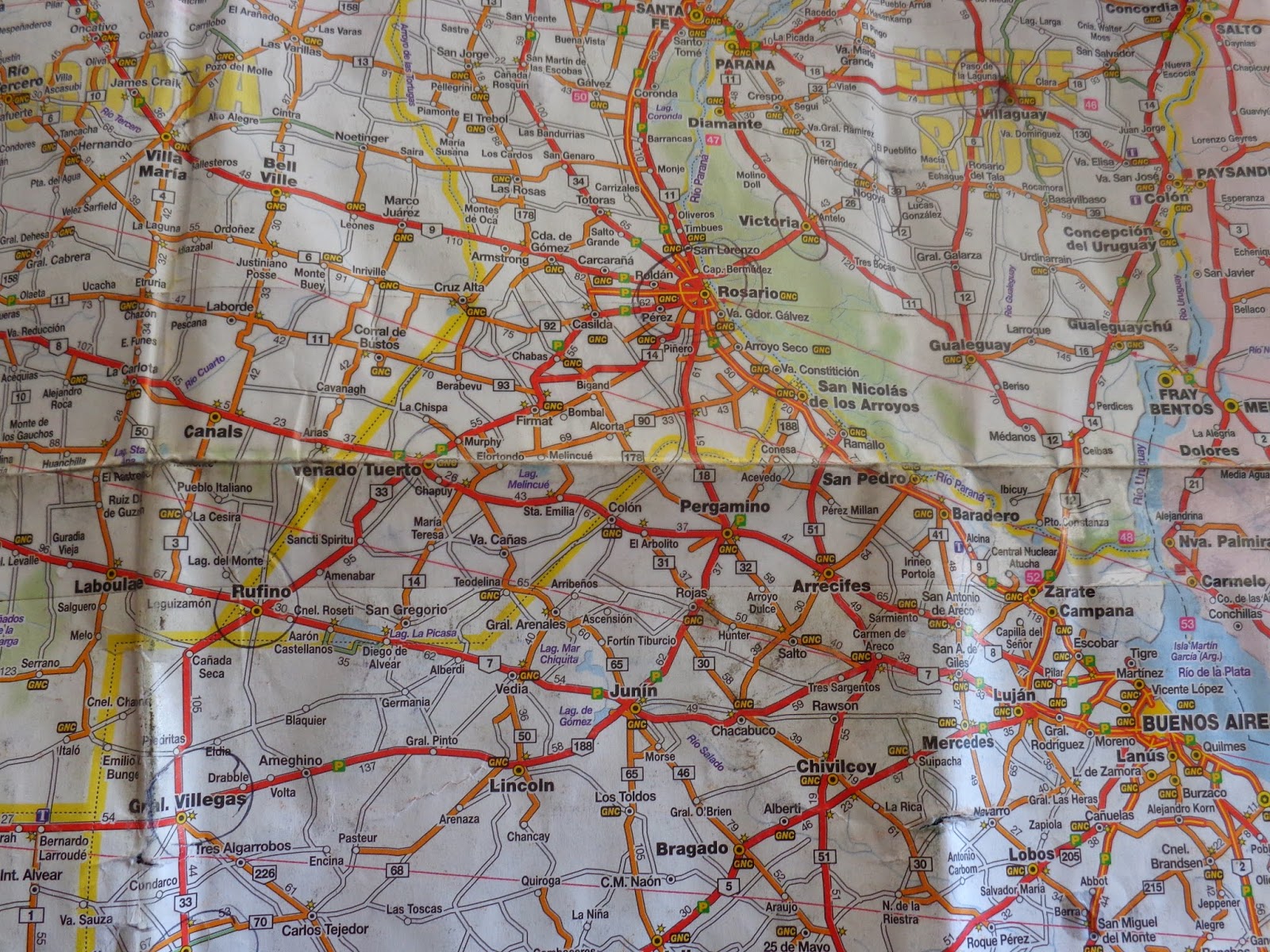
Tent down, face washed, coffee and back on the road, there was lot of ground to cover so I tried to get riding by mid morning and make distance through the provinces of La Pampa, Cordoba, Buenos Aires and into Santa Fe on a good afternoon. I was approaching the periphery of the country's industrial heartland, busier roads and grumpier faces. I'm now blending in with the middle aged men eating lunch alone in simple restaurants, staring at the television, picking at the bread from our baskets until the hot meal arrives.  

The weather was mainly fine until the skies opened up above and turned a dark shade of grey by late afternoon. Despite thinking I'd waited out the storm coming from the north in a gas station lounge, I got caught in the dark for 100km's in a mix of thunderstorm and torrential rain, drenched to the bone until escaping in the closest highway town of Rufino for a hotel bed for the night. To make matters worse, the highway was frequented by many trucks and clearly no weighbridges in this part of the country as the tarmac was unpredictable and difficult to see the deep waves due to overloaded trucks. Perhaps the most dangerous riding I've endured.


A day later I cross the Rio Parana, an instant tropical change and miles of riding through the wetlands. On a rare occasion after months in Argentina, the police at the provincial checkpoint pull me over rather than wave me through. License and bike title isn't enough this time, they ask for my insurance. ''What insurance?'' I say, ''I don't have insurance in Argentina''. ''But it's compulsory, you must have third party insurance in Argentina''. ''I didn't know that, customs never asked me at the many border crossings I've made, the police have never asked me up to now''. I thought it would blow over and they'd let me carry on, but with a group of cops now around me, one of the guys was out to make a point. I was forced to pull over, brought into the roadside office and sternly shown the road laws and a schedule of offences and the corresponding fines, $1,400 pesos for lack of insurance, that's somewhere around $190 aussie dollars now that I had very little cash and would be potentially forced to use my bank card at official rates.

I casually laughed it off and did my best at playing the subtle balance of ignorance, patience, innocence, surprise, frustration and dumb gringoness. He had my title and license so I had little room to move. ''What are you going to do'' he asked. ''I don't have that money'' I insist and stick to my story that I repeatedly asked customs officials at every crossing into Argentina and they say insurance isn't compulsory so I haven't bought it. Being a Saturday the bank isn't open so I'm told if I don't have the cash I have to wait until Monday to make the payment. ''Monday! What am I suppose to do til then? Where do I put my tent?''. ''Over there points the older cop, beyond the guard rails.

I'm sent out of the office and forced to wait by the roadside until something further. Several hours go by, they're waiting for me to give in I figure. I've found patience is always the way to go in these situations so I sit and watch the traffic go by. As it gets dark, I fetch my tent from my bike and set it up where I was told was possible. No one approaches so I get my sleeping bag out and settle in for a documentary then some music on my laptop. A few hours later, at 11pm, I head out of the tent to take a piss, hoping to catch someone's attention, surely they won't allow me to camp by the highway overnight. As I'm shaking off one of the senior cops shines his torch my way and calls me over. ''Cold, hey'' he says. ''What do you think?'' I reply, making it sound a lot colder than what I was used to further south. ''Go on, pack your stuff up, get out of here''.

After six of so hours, he agreed to give me my documents back and continue on the highway. I approached the office and the cop inside had a few questions for me. ''So, what's your job? You're a dentist aren't you?'' ''No, I'm not a dentist.'' ''You're a doctor''. ''No, I work in construction. Why?'' I find out he'd been google-ing me during this time and mistakened me for a dentist from California. Maybe that got me out of the fine, who knows, but he kindly wrote out a formal fine in case I was caught further on I could plead guilty and say I'd already paid the fine then we sat by the computer while I showed him my blog and what I'd been up to in Argentina. Tough going but luckily I wasn't far from a town so I took a hotel room for the night.                  


Packing my bags in the car park the following morning I meet Pancho, a Chileno riding east to Brazil for the World Cup. We compare maps and routes and decide on riding together for the day. It's not much chop riding alongside a 200cc cruiser, often not realising Pancho is out of my rear vision so I make some stops so he can catch up. Over lunch and perusal of our maps, we spontaneously decide to cross into Uruguay shortly for a change of scenery. My lack of insurance comes to bite me again, I pass through both immigrations and customs before a man approaches me and says I can't enter without insurance. What frustrates me most is that if insurance is compulsory, as it is in some less developed Central American countries, there should be facilities at the borders to purchase it. At the crossing I had no option but to return to Argentina for the night. I had to leave Pancho behind, fix insurance in the border town the next morning and re-enter that afternoon. 


Sun setting over the Rio Uruguay in Belen with Argentina in the distance. The most precious thing about leaving the Andes is riding and resting with sunsets like this across the broad plains of Argentina and northern Uruguay. To take a memorable line from my eternal buddy Phil, riding into scenes like this just never gets old, first heard the evening of our sunset ride into Comodoro Rivadavia now months ago further south.I didn't stay long but I'll be returning to Uruguay after Brazil, my first impression was of a similar feel to Cuba, but functional, perhaps what a democratic Cuba would be like - fields of quality farmland, deserted highways, old cars and simple living.      


When I turned off the highway for a night in Belen and some petrol I was given directions from these two hitchhikers only to meet them shortly after by the river where I decided to camp. Carlo and Lalo were true bohemians, the sons of freemasons who had spent the past decade on the road between odd jobs, spending time in all corners of their country and well as the neighbouring countries. I spent the night trying hard to understand their thick accents, shared some cask wine and a slow cooked pasta fagioli over a campfire.   


Tuesday June 3, 2014. I wake up with the sun by the river in Uruguay, hug it out with my new friends, get on the road early, cross freely into Brazil, stop for coffee, cross into Argentina a couple of hours later, throw down an average plate of ravioli for lunch and take the 12 towards Misiones province and the sub-tropics. This is the sun setting on approaching Luis' place at day's end.


Sixto's room with a view
 
After a long day of over 500km's on the road and three countries, seeing the sun setting as above is enough to call it a day and watch it melt away. I was in need of a wash so when seeing a restaurant sign on the highway with 'toilets and showers on offer' I made a U-turn and pulled into the driveway. As soon as I got to my feet, a jolly man presented himself. I asked if I could camp in the front of the property and maybe use the shower. In true Argentinian fashion there was no hesitation, Luis suggesting I park beneath the undercroft. I watch the last of the light with a couple of avocados fallen from the tree and soon enough I'm introduced to a couple of guys who work there as well as a couple of others who have come to drop off some timber. Then arrives Luis' gentle father and brother Lolo who insists the night will be too cold for camping and suggests I set up inside a small brick building away from the wind. I'm invited in for a beer and find a new energy for some interesting chat with a friendly group of guys, all connected with the restaurant. Later on Luis and one of the guys get on the guitar and drums in the corner of the restaurant for a private session of folklore music from not just this part of the country but samba from various areas until we share a great plate of rice, lentils and pancetta.  


With Luis and his father. I farewell Luis and the boys and head to Puerto de Iguazu the following morning after I'm fed an energizing Argentinian breakfast - a big cup of cafe latte, bread and dulce de leche and a lesson on the secrets to making perfect bread by the padron. A fantastically warm family and more unforgettable hospitality.   


Why doesn't this happen in the more developed world? I made a brief stop on the highway to Puerto where a man was grilling from a 40 gallon drum on his trailer by the road, $2 got me a well roasted piece of pork belly, a chorizo, chimichurri, a basket of bread and a glass of water.


May 29, 2014

The road to Cuiaba` - Part I


With a final plate of lentils under my belt, a freshly baked loaf of bread under my arm and a warm farewell and mutual thankyou with Ghila, I road away from Lago Puelo three days ago. The past few weeks have been a rewarding experience and one I've learnt a lot from. I'm now comfortably on the road to Cuiaba` where Australia meets Chile in their, or our, first match of the World Cup finals in 16 days time. I'm travelling some 4,600km's in a north east direction to the Mato Grosso region of Brazil as I've just secured tickets to Australia's three group games and a chance to spend time with my cousins Rob, Steve, Laura, their partners and my Uncle John amongst other friends and later on, Luca and Amy. Some familiar faces and party atmosphere await. 

Suprisingly, there hasn't been too much hype in the past few weeks around here, a lot of Argentinians I speak to are either indifferent or hold reserved expectations. The last few days on the road however, when chatting to someone at the traffic lights or a gas station attendant who ask me where I'm heading, I now say I'm heading to Brazil for 'el mundial' which gets a smile and the excitement is starting to build. From many years ago, I knew if I was ever to get to a World Cup in my lifetime, Brazil would be the one, perhaps the most football nation of them all and renown for putting on a party, where else would I want to be heading right now?

So here I am with a new purpose and enthusiasm to my riding, knowing in the back of my mind that the end of these endless numbered days is nigh and a great opportunity is approaching to celebrate a global culture coming together. From my recent reading, we don't stand much of a chance to impress and should be lucky to salvage a point from some observers, however I'm hopeful that if the inexperienced squad finds that resoluteness from a generation ago, we should do just fine and keep some pride intact. Here's to an optimistic view and trust in the current coach. 


                 No end to La Pampa from above

I spent my first day back on the road battling the winds and farewelling the snowy mountains which disappeared when arriving in the wine, apple and dinosaur roaming province of Neuquen. I stopped to camp above a lake, hoping I would be escaping the cold shortly. Yesterday I crossed into La Pampa region and the quintessential Argentinian outback of fertile plains and vast open spaces. As the sun was setting I was miles from anywhere, a sign indicated a town 100km's away with a symbol for gas and camping so I decided to ride through the darkness to rest there for the night. I arrived at what was barely a town, Lihue Calel doesn't even show itself on my map, there was petrol, and a sign saying Restaurant and Motel. Nothing else. In I went to get away from the chill and didn't leave for several hours. As soon as I approached the fire to warm my hands I got chatting to a friendly man, Roberto and his partner from the closest city and before I knew it we were sharing bottles of beer and I was convinced to order the roasted beef, they wouldn't let me pass through La Pampa without trying its prized beef. We got chatting about the usual topics, where I'd been, what I thought of particular places, people, dangers, dismissing stereotypes, life in Australia and advice on where i was heading, east of the Rio Parana. The owner joined in the chat before Roberto insisted he pay for my meal and drinks before leaving with plans to meet again and I continued the chat with a table of cattle farmers who had all the economic questions for me and ideas on farming kangaroos here. I finished the night camping by the lonesome tree and climbed the hill this morning to get a better view of the endless landscape around me.
 
Today I rode for a short few hours in a straight line with the sun in my face to the crossroads town of Santa Rosa. It's great to be back on the road.          
   

May 28, 2014

Slow living in Lago Puelo


I've been living slow in Lago Puelo for the past few weeks. I was put in contact with Ghila, an Italian woman who lives here on her four hectare Chakra with her two young children and I've come to volunteer and wander around the property. There's snowy mountains surrounding us, streams and a river to the rear and whole lot of dogs, cats, chickens and a horse named Moro.
The place is ran as a guesthouse, holding workshops 'for a better world' as the sign by the main road has it, in meditation and yoga with live music during the summer when the place comes alive. There's a new age sense to the place with Ghila's attitude, the furnishings, music, and activities. It's very much low season at the moment and will continue to be until the winter's end but there's still been a slow stream of travellers passing through who I've spent many laughs with over dinner, even cooking for a late arrival of six guests one evening on short notice.  


I'm sleeping in my favourite of the mud houses and given an open kitchen to use in exchange for physical and repair work needing attention around the place. Fresh chicken eggs have never tasted so good and with a house of vegans I get them all to myself. It's very relaxing with so much beauty around and it makes me content to get my hands working, whether its mud, washing clothes or kneading dough for bread or pasta.
 
Today I'm taking a rest to take a slow walk out to the nearby lake but other days I'm making an earth mix and plastering mud on to one of the huts to improve it's thermal properties, I'm painting on top of it with a lime and clay based mixture. Then there's fences and roofs to fix, attending to the compost, searching for eggs and cooking something simple for myself. I'm sleeping in and working with the sun, life is peaceful. 


I went out with a guest to the nearby pine forests to forage for pine mushrooms but all we could find were 'slippery jack's' which aren't worth the effort of cooking, too bland.


This is my little project, mud plastering Diego and Agostina's place. I first whisk flour and water then add it to sieved clay, sieved sand, topsoil and a handful of straw. It's a joy to work with as long as the sun is shining on my back. Even more so as Diego and Agostina are a very nice couple, Agostina feeds me jam from the wild fruits growing nearby and Diego has a real talent with the guitar, enough to keep me working once the sun goes down on an unforgettable evening.


Plastering Diego and Agostina's hut to the back of the property.
 

When Jeronimo arrived at the Chakra he was keen to hike up to Cerro Lindo, one of the tougher treks so I joined him to get out of the farm gates and into the wilderness for a couple of days. Sixto took us as far as the road would allow before we began the tough, steep hike but a great time of the year to be doing it.


Chilling out with Jeronimo and Raul at the refuge, talking shit away from the chilly weather. Raul is surely the coolest refuge lodger I've met, a real Argentine dude, full of chat and laughter. Being the only two guests, we put our food together and cook over the wood stove for two nights, someone's fetching firewood while the others are rolling cigarettes or pouring mate` in the shared cup. A touching mountain experience with two great guys.


A not so happy moment. Two days quickly became three when we took Raul's loose Argentinian style instructions on the second day to get to the waterfalls. The further into the valley we hiked, believing we could follow the mountain around and back to the refuge, the deeper we went and lost all sense of bearing so we had to follow our steps instinctively to arrive back by dark with appetites like lions and head back the following day.


One of the highest lakes in the area, ready for a long approaching winter
 
 
Clouds in the valley over El Bolson with fresh sun above


May 22, 2014

North, south and through the lake districts ......


I'm on highway 5 from this point, sitting on cruise control on this straight and uninspiring stretch but it gets me moving quickly and effortlessly after the tiring riding and rainy days of the week gone. I'm away from the gusty winds and the stray dogs appearing from everywhere when I have food on my lap. I'm missing that Patagonian feeling from here on, that humble sense of life, the fireplaces, the isolation, the use of recycled materials, those foggiest of mornings, the lakes, the list goes on ..... 

There's not much going on in Osorno when I stop on a Saturday, just some friendly folk in a bookshop, more mediocre Chilean food and a cheap bed in a dilapidated building beneath a loud family. Before setting off the following day I get in contact with Monica, an aunty of Gilda's, those that have known me long enough may remember Gilda, who kindly put me in contact with family of hers here and before I knew it I was given a warm welcome and offered a fantastic home cooked cordero, roasted lamb over a Sunday afternoon fire. I spent the following few days here in Temuco with a place to stay in Maury and Natacha's home, just a short stroll from the centre of town and their little cafe. I took time away from riding, just wandering around the city which I hadn't done in a long while, hanging out and getting to know Maury, while witnessing the middle class Chilean lifestyle. They were a warm and welcoming family and provided an entertaining time. My next stop was off the highway in the port city of Concepcion, where I spent an evening with Jamie Rodrigo, an avid motorcyclist and the friendliest of gentlemen who took me out for dinner and a tour of the city, devasted by an earthquake a few years ago before insisting I take his spare riding jacket for the journey ahead.

I decide to continue north from here, towards Santiago for some new tyres and a couple other parts from the Triumph dealership and a chance to catch up with Ian who had now taken a rest from riding and settled into an apartment in the Chilean capital. I get my bike stuff organised and spend the next four days hanging out with Ian at his apartment, watching sitcom reruns, walking the streets and a heavy night out with some locals and Ballarat Lauren I'd met in Ushuaia. Five days of concrete jungle living was enough to get me back on the road. I decided from here I would head back for the Argentine Patagonia and find some voluntary farm work where I could stop again and take in the air before the long journey across to Brazil for the football World Cup in June. 


I traced my steps of the previous week, covering a massive 850km's to reach the lakes district town of Pucon after dark, to spend a few days of sunshine in a hostel and taking in a half day secluded waterfall hike before crossing back to Argentina. The petrol in Argentina is nearly half the price of Chile so I took a gamble when crossing with little left in the tank, expecting there to be a town and petrol station at the frontier which is usually the case. This small crossing was within a national park however with a stunning volcano on the border. The immigration officer told me the next gas was 70km away. I couldn't convince any one of the customs officials to give me some petrol, everyone seemes to be running on 'diesel' and there was no hose around, as was the case with the army and national park officials further on. So I had no choice but to sit and wait for some help, asking each car that passed until a kind North American offered me the litre of fuel he had for his cooking stove in back of his car. The litre saves me and gets me off the gravel and back on to Ruta 40 towards more lakes and quaint towns. 

     
Arriving in Junin de los Andes - more autumn camping with a soft, leafy mattress and those ibiquitous Argentinian grills to myself until the dogs arrive. More fishing here in the country's capital of trout fishing still brings no luck. I'm happy to be back in Argentina, now the country I've spent the most time in, it's always a pleasure to meet the old men, curious and relaxed and the young guys, polite and friendly. The week's highlight is riding la ruta de los siete lagos, the seven lakes road from Villa de Angostura to Bariloche. It's the imaginable curvy, mainly paved road which hugs the shorelines of several lakes and travels high above them. With afternoon sun then clouds ready to burst there's a lot of views to take in on a satisfying day. 


My favourite of the lakes


For all its hype Bariloche disappoints, just a tourist trap sitting on the least picturesque of the area's lakes. I quickly get out, make a Sunday afternoon stop in Colonia Suiza and the village market and treat myself to an all you can eat pit barbeque cooked over stones and covered for a couple of hours. I'm seated with a BA family and a jolly old man who entertain me along with the folklore music for the afternoon.


On arriving in El Bolson, the so-called hippy capital of Argentina, with it's artisan markets, microbreweries, abundance of wild sweet fruits and ideal location tucked within the valley of towering hills, I was hoping to find some work on one of the trout farms near town but all three said they weren't so busy so I hung out with Lucas while waiting for some replies to other farms. We were both camping at the local brewery. The old fella, Juan Carlos owned the brewery and suggested if we made fresh pasta (with rolling pin) he would provide prawns for the sauce and the wheat beer for our last meal together. Happy days. 
 

April 29, 2014

Autumn in Patagonia


Video footage of my past couple months in perhaps my favourite part of the Americas. Play with music.

April 26, 2014

A highway named Austral, a park named Pumalin


Leaving mighty Mt. Fitz Roy behind
 
 
I return to Ruta 40 following earlier stints further north on this glorified adventure highway which runs the length of Argentina. It takes me up most of the way to the crossing back into Chile. There's some sections of freshly laid gravel with little compaction which makes for a slow journey, the landscape is flat with little to see other than watching the guanacos scurry away as I approach and stopping to witness a condor circle above me.     


Within a couple of days later I was focusing on working my way up Chile's narrow corridor. My stint of hiking days on end may have taken a breather but there was so much more of those Patagonian forests to experience and the roads were about to get more interesting, more curves, more gravel and less wind.  It's a fascinating country geographically - it's thirteen times longer than it is wide, the Pacific stretches along its entire western frontier until it meets the Atlantic, the Andes soar to its east, the desert to its north is the driest place on earth yet cloudy and cool and the south is islands, mountains, glaciers, fjords, plains, lakes and pristine temperate rainforests. The beauty of the south resounds in the words of the national poet, Pablo Neruda - 'He who does not know the Chilean forests, does not know the planet'. If the variety is not enough the country is famously prone to natural disasters - it sits near an earthquake prone belt and is home to over 2,000 volcanoes, 48 of which have erupted in the last 100 years.

I'm sure I've written this one before, it's yet another Latin American country where the U.S supported a military coup. Within three years of Allende's democratically elected Marxist government coming to power in 1970 under a policy of nationalisation of industry it was overthrown by the armed forces and federal police with strong backing from the U.S. Nowadays, it's cleary the most progressive country in Latin America at face value. Things seem to work and move here, advice is more reliable, my pockets are full of unnecessary receipts and it's difficult to bargain with people. Hostel owners are more likely to walk with me down the street to a cheaper place rather than settle for my slightly lower suggested price.     


Naturally, it's also the most expensive country, for food, a campsite, a hostel bed and putting petrol in the tank. It still confuses me that a litre of beer and a litre of petrol are of similiar price. I've learnt to stock a bag with bread rolls which suprisingly stay edible for few days and go well with a glug of argentinian olive oil and a tomato or two.

I crossed back into Chile, maybe the fourth time now, from near the southern end of the Carretera Austral, that famed southern highway which was built by the military during the 70's and 80's to connect the isolated communities of southern Chile with the rest of country. I'm told that before this, there were very little people living down here, the extreme weather conditions even kept the indigenous away. With improved access, the government gave land away to those willing to maintain it in an attempt to encourage development and protect the country.  

I wish I had better photos but I clumsy left my camera atop my bags when I was filling up on my first day on the Austral, once I eventually realised I found it a couple hundred metres away crushed on the road, memory card still intact. I should have some footage from the video I'm putting together though. My ipod also stopped working that day and to top it off, I snapped my fishing rod in half when I tried to loosen the lure from a rock on an evening fish. I found a great secluded spot to camp by the river than clear night, gaining solace in my ideal surroundings.

I rode a 500km stretch of the highway for over a week along mainly unpaved, curvy roads through the steep mountains and thick forests, stopping at isloated villages and taking several ferries across a lake and through the majestic fjords. It's a quiet, adventurous road with very little traffic, mainly trucks, some cyclists, hitchhikers and the odd stop for roadworks. When a car passes, there's always a wave. On taking some back trails I find some untouched areas, perfect for fishing in the clear waters or to stop for lunch. I also found an interesting trout farm to visit.


I stopped in Chaiten one evening, a so called ghost town since the nearby volcano erupted six years ago and covered much of the town with a metre of ash, reaching the windowsills of homes. It's previous eruption was 9,000 years ago. The devastation occured after the second eruption, four days after the initial one well after the town, 20km's to the south, was safely evacuated. Chaiten remained unoccupied for two years until with permission, residents began returning. Six years on, the population is less than 20% of what it was. After camping at a friendly lady's front yard, I stocked up on supplies (bread, pasta, tomato paste, tuna, sardines, chocolate and nuts) and entered into the nearby Park Pumalin, a paradise of temperate rainforest which is home to Volcan Chaiten and another larger volcano along with stunning lakes, rivers and diverse flora. 


The Park was set up several years ago by Doug Tompkins' Conservation Trust - he's commonly known as the founder of 'The North Face' outdoor clothing label. His ambition is to protect the native area from logging, his larger focus is to protect and save vast areas of Patagonia, the world's last remaining wilderness. It's a brilliant park, truly beautiful. I hide away here for four days, having a campsite and most of the park to myself, getting to know some of the workers, feeding the birds, watching the rain fall for four continuous days and celebrating Sixto's first birthday with some cask wine. There was great trails to hidden waterfalls and lakes but the highlight was hiking up to the crater of Volcan Chaiten. It was quite an eerie and exciting experience, few of the trees are more than trunks but alot of the plants have re-grown. The foggy and misty weather made the track quite unclear so I needed to made deep footprints in the soils in order to trace my path back down, reminded of what happened when I last climbed a volcano solo in Nicaragua. I finally leave the rain behind and push north through some blisteringly cold and windy days of ferries and muddy roads, reaching Puerto Montt. Sadly, raw Patagonia disappearing behind me but I'll be back shortly I hope. 


April 13, 2014

Only in Patagonia: 8 days of Paine, a field of ice and a mountain peak like no other

 
Los Cuernos

After the recharge in Ushuaia I reunite with my travelling group as they lounge around Mario's living room at his home in Punta Arenas waiting for him to return from parent teacher interviews so we could organise dinner. It's a tough twelve hour ride to arrive, freezing conditions on the mountains above Ushuaia where the early morning icy road comes without much warning, the strong head winds, border crossings and poor road conditions mean I miss the scheduled ferry and take a detour to get on board the smaller boat across the strait. In such a scarce location I wonder where the next gas station is when returning to the continent with less than half a tank so I decide to pull over and wave down the next car that eventually passes. The man stops, winds down his window and says it's not for over another 100km's or so which leaves me in a bad spot. At second though he remembers one which may be open off the highway and tells me to follow him until the crossroads where I should turn to the left. I eventually find it and not long after he's pulled over on the side of the road with his boot open waiting for me and showering me with a can of coke, coffee from a thermos, biscuits and a long chat. Gonzalo is yet another middle aged Chilean man who makes me feel welcome for entering his country. I only stayed at Mario's for a night, heading off with Phil, Ian, a new backpack and four litres of engine oil, we lost Jayne who was heading east but now included Dan, a friendly Californian, who we met in Ushuaia. The four of us pushed it through to Puerto Natales that afternoon stopping halfway as the lack of any petrol stations forced me to siphon from Phil's tank before running out. The joke was on me when Ian offered me a big black hose to use which make it difficult to not get petrol caught in my mouth and the taste to remain through the day. Only once I had struggled did Phil presented a much thinner translucent hose to finish the job. Phil and Ian's schedules brought on a farewell and one last night of drinking and Ian offering up his guitar skills at the open mic bar before Dan and I prepared for our ventures in the nearby Torres del Paine National Park.


I planned on spending eight days or so in the park and I'm glad I managed to get through it. It was one of the most enriching experiences of my trip, to wander amongst legendary mountains and granite walls, along turquoise lakes and glacial fields, across rivers and up and over the John Gardner pass to descend into a heavenly valley. Eight days of confronting whatever the unpredictable Southern Patagonian autumn weather wanted to through at me, setting up camp every night, trying to outsmart the camp rangers to avoid paying the fees, growing tired of dehydrated meals, running short of chocolate and nuts and hiking through 120km's of the full 'Q' circuit and one of the worlds classic hiking routes. It wasn't too difficult other than the 5:30 subzero rise for the sunrise view of the Torres, hiking through snow on the 1,200m ascent on reaching the pass and the ever strong winds on Day 4 which kept me up all night to preserve my tent whilst others around me tore away and forced my neighbours to sleep inside the refugios. I commenced alone with my 45 litre pack with tent strapped to the sides and although I preferred to walk mostly alone, I joined up with some friends I made early on every evening to share dinner and portions of some days walking. Cherlotte and Jean-Beautiste we're experienced hikers, being around them taught me to take in as much as possible of what was around me. Sharing the arduous hike together on the second day up and over the pass followed by a long descent through a deep valley and muddy woodlands will stay with me forever. I was so exhausted that evening that when I woke to a deserted campsite the following afternoon I realised I had slept 16 hours to recover. 16 hours in a tent on hard ground in a cold forest. The other group on the same circuit was an American-German trio who were also great company to have dinner with and have a laugh and share each others reactions or struggles over the day's events.


A few days in I really began to appreciate this different approach to experiencing the natural world and seeking a fresh peace of mind. I walked for hours, stopping to drink from the clear streams, to sit silently at a viewpoint above a lake or glacier or to take a breather to chat to a hiker coming the other way to discuss conditions after passing no one for a couple of hours.

Hiking thus far had not taken me to such wild places for such a period of time and although I've always enjoyed the views and perspective from the seat of my motorcycle and still do as much as ever, the physical and uncompromising effort was having a real impact. The surroundings felt more peaceful, it was wet but I was far from cold, there was no man made engine between my legs to move me, no tank of fuel where it's energy was derived from beneath the earth and certainly no clutch and gears to adjust when the climb was adding a little strain. There was just my legs, a series of clothing layers and unavoidable sweating. I was reminded of and found some clarity to what an avid hiker I met in Ushuaia said to me, that she was a better person when in the mountains. Places like these, moments like these, keep us honest and humble, the physical exertion frees our mind and the wilderness speaks a raw truth which cannot be avoided.


Above are the 'Torres del Paine', the signature piece of the park. Jean-Bautiste woke me before sunrise for the hour hike up to the lakes surface in anticipation for the moment when the sun would rise over and reach the towers. This vision will also stay with me forever, the sun's rays striking the granite towers as if declaring the dawn of time.


Hiking along Glacier Grey for two days which is on the edge of the Southern Patagonian ice field, the world's third larger continuous sheet of ice after Antarctica and Greenland.  


I took a couple of rest days on returning to Puerto Natales before crossing back to Argentina for an early morning visit to Glacier Perito Moreno further north. A great view of the ice from the balconies, hearing a thundering crack and anticipating a large chunk to crash into the waters but not quite as enjoyable as being able to walk alongside it for hours like in the park.


I was next on my way to El Chaiten, the home of two of the Andes most prominent peaks, Cerro Torre and Mt. Fitzroy. It's a cosy little town, not as overrun as it could easily be with the tourist interest and find a warm young family to stay with. I spent three days hiking around the park here, the autumn chill had really turned campers away so I find my tracks aren't covered much by others who have mainly arrived for day trips into the park. I experience some cold nights and wake to snow covered forests. The hiking here is as good as I've come across, the woodlands, strong and healthy rivers and some breathtaking mountain tops.       


Reaching the lake at the base of Mt Fitzroy mid-morning in the glistening sunshine makes you feel on top of the world. I hope the photo says enough here, my best attempt at describing the Patagonian Andes. Makes you dream of wanting to become a rock-climber. I had the pleasure of gazing at this part of the mountain range for about 70km's on the ride into the town which sits directly below it however, at this proximity the detail and complexity in the rock is so vivid, leaving you in awe and difficult to take your eyes off such a incredibly imposing and dramatic masterpiece.


Cerro Torre in full view after the snowing and clouds disappear